
2D icons › Bioinformatics & data
Bioinformatics & data: 404 flat 2D icons
Flat vector icons drawn by BioDiorama, free to use with no credit required. Every colour is a setting, many have further settings, and they export as real vector in layered SVG, PDF and editable PowerPoint. Open the 2D Studio and type the name into the search box.
Neural networks · AI & computing hardware · Machine learning · Molecular docking · Molecular dynamics · Structural bioinformatics · Sequence alignment · Read mapping · Assembly · Phylogenetics · Sequence analysis · Comparative genomics · Omics · Single-cell · Spatial omics · Networks · Workflows & pipelines · Code symbols · Code & notebooks · Computing infrastructure · Data storage · File formats · Data management · Devices & dashboards · Lab automation & LIMS · Software development · Neural coding · Sequencing chemistries · Long-read sequencing · Library preparation · Single-cell methods · Spatial methods · Chromatin profiling · DNA methylation · Transcriptome methods · Mass spectrometry · Proteomics · Metabolomics · CRISPR screens · Functional genomics · Metagenomics · Genome assembly · Variants · Population genomics · Genomic data views · Sequencing QC · Single-cell analysis · Multi-omics integration · Immune repertoire · Spatial analysis
Neural networks 15
 Feed-forward neural network
 Deep neural network
 Perceptron (artificial neuron)
 Convolutional neural network
 Convolution filter on an image
 Max pooling
 Recurrent neural network (unrolled)
 LSTM cell
 Transformer block
 Self-attention between tokens
 Autoencoder
 Variational autoencoder
 Generative adversarial network
 Graph neural network (message passing)
 Diffusion model (noising and denoising)
AI & computing hardware 5
 AI chip (neural processor)
 Graphics card (GPU)
 Memory module (RAM)
 Storage drive (SSD)
 Quantum computing (qubit)
Machine learning 19
 Activation functions (ReLU, sigmoid, tanh)
 Model training loop
 Protein language model
 Protein structure prediction
 Decision tree
 Random forest
 k-means clustering
 k-nearest neighbours
 Gradient descent
 Confusion matrix
 k-fold cross-validation
 Underfitting and overfitting
 Reinforcement learning
 Large language model chat
 Feature importance
 Hyperparameter search (grid)
 AI brain (artificial intelligence)
 Transfer learning (fine-tuning)
 Saliency map (model attention on an image)
Molecular docking 8
 Docked ligand in a protein pocket
 Ligand docking into a binding site
 Docking poses ranked by score
 Virtual screening funnel
 Compound library
 Docking search box over a binding site
 Pharmacophore model
 Protein–protein docking
Molecular dynamics 10
 Molecular dynamics simulation box with water
 Force field (bonded and non-bonded terms)
 Bond stretching (harmonic spring)
 Free-energy landscape (two basins)
 Free-energy surface (3D)
 Protein folding funnel
 Coarse-grained bead model
 Periodic boundary conditions
 QM/MM model
 Thermodynamic cycle (relative binding free energy)
Structural bioinformatics 8
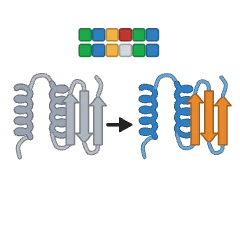 Homology modelling
 Electrostatic surface of a protein (Structural bioinformatics)
 Binding pocket detection
 Structural superposition (RMSD)
 Residue contact map
 Conformational ensemble
 Solvent-accessible surface (probe sphere)
 Elastic network model
Sequence alignment 4
 Pairwise sequence alignment
 BLAST hits on a query
 Multiple sequence alignment
 Sequence logo
Read mapping 13
 Sequencing reads mapped to a genome
 Variant call in a read pileup (SNV)
 Insertion and deletion (indel)
 Structural variants
 Genome browser tracks
 Paired-end reads and insert size
 Read coverage (depth) along a gene
 Peak calling (ChIP-seq, ATAC-seq)
 DNA methylation at CpG sites
 Single-cell read structure (barcode and UMI)
 Demultiplexing reads by barcode
 Read trimming (adapters and low quality)
 Long reads and short reads
Assembly 3
 k-mers from a sequence
 De Bruijn graph
 Genome assembly: reads to contigs to scaffold
Phylogenetics 5
 Phylogenetic tree (rooted, rectangular)
 Cladogram (slanted tree)
 Phylogenetic tree (unrooted)
 Phylogenetic tree (circular)
 Time-calibrated phylogeny
Sequence analysis 10
 Sequence to function prediction
 Open reading frames (six frames)
 Motif discovery in sequences
 Profile hidden Markov model
 CRISPR guide RNA design (target and PAM)
 PCR primer design
 Plasmid map (annotated)
 Translation: codons to amino acids
 Gene model (exons, introns and UTRs)
 RNA secondary structure prediction
Comparative genomics 3
 Synteny between two genomes
 Karyotype ideogram with marked loci
 Haplotype phasing
Omics 3
 Omics layers (multi-omics stack)
 Multi-omics data integration
 Cell-type deconvolution of bulk data
Single-cell 3
 Annotated cell types on an embedding
 Gene-by-cell count matrix
 Batch-effect correction (integration)
Spatial omics 1
 Spatial transcriptomics (spot array on tissue)
Networks 6
 Signalling pathway diagram
 Protein–protein interaction network
 Gene regulatory network
 Chord diagram (cell–cell communication)
 Network modules (communities)
 Biomedical knowledge graph
Workflows & pipelines 4
 Analysis pipeline (workflow)
 Directed acyclic graph (DAG)
 Parallel jobs (scatter and gather)
 Algorithm flowchart
Code symbols 6
 Curly braces { }
 Code tags </>
 Lambda (functional programming)
 Summation Σ
 Function f(x)
 Loop (iteration)
Code & notebooks 6
 Code editor window
 Command-line terminal
 Computational notebook
 Version control (git branches)
 Code changes (diff)
 API (request and response)
Computing infrastructure 7
 Software container
 Virtual machines on a host
 Cloud computing
 Cloud storage (upload and download)
 High-performance computing cluster
 Server
 Job queue (scheduler)
Data storage 4
 Database
 Database search (query)
 Relational database tables (schema)
 Data lake
File formats 13
 FASTA file (sequences)
 FASTQ file (reads with qualities)
 BAM file (aligned reads)
 VCF file (variants)
 BED file (genomic intervals)
 GTF/GFF file (gene annotation)
 CSV file (table)
 JSON file
 HDF5 / AnnData file (single-cell data)
 PDB / mmCIF file (3D structure)
 mzML file (mass spectra)
 FCS file (flow cytometry)
 TIFF image file (microscopy)
Data management 16
 FAIR data principles
 Data sharing
 Data privacy (protected data)
 Encryption (key and encrypted data)
 De-identified records
 Federated learning
 Big data (binary stream)
 Data cleaning (filtering)
 Merging datasets (join)
 Extract, transform, load (ETL)
 Compressed archive (gzip)
 File checksum (integrity)
 Metadata tags
 Ontology (term hierarchy)
 Spreadsheet
 Electronic health records
Devices & dashboards 5
 Data dashboard
 Laptop with data analysis
 Desktop workstation
 Web tool (browser)
 Internet and networks
Lab automation & LIMS 3
 Lab automation robot with LIMS
 Sample barcode tracking
 Electronic lab notebook
Software development 7
 Software bug (debugging)
 Software tests passing
 Software package
 Software release (version tag)
 Continuous integration (build, test, deploy)
 Documentation (manual)
 Benchmarking (runtime comparison)
Neural coding 4
 Place field
 Grid cell
 Centre–surround receptive field
 Tonotopic map
Sequencing chemistries 14
 Patterned flow cell (nanowell array)
 Exclusion amplification in a nanowell
 Two-channel base calling (red and green images)
 DNA nanoball (rolling-circle amplicon)
 Avidity sequencing (multivalent nucleotide polymer)
 Pyrosequencing well (bead and light flash)
 Pyrogram (light per nucleotide flow)
 Emulsion PCR on beads
 Phasing and prephasing in a cluster
 Index hopping (swapped sample indexes)
 Sequencing by ligation (dye-labelled probes)
 Capillary array electrophoresis (Sanger instrument)
 Flow cell lanes, swaths and imaging tiles
 Sequencing run cycles (read 1, index reads, read 2)
Long-read sequencing 10
 SMRTbell template (hairpin adapters)
 HiFi circular consensus (passes to one read)
 Nanopore sensor array (membranes over wells)
 Motor protein ratcheting DNA into a nanopore
 High-molecular-weight DNA spooled on a glass rod
 Adaptive sampling (rejecting a read at the pore)
 Optical genome mapping (labelled molecules in nanochannels)
 Linked reads (one barcode per long molecule)
 Cas9-targeted enrichment for long reads
 Haplotype-phased methylation on long reads
Library preparation 19
 Focused-ultrasound DNA shearing
 Enzymatic DNA fragmentation
 End repair and A-tailing
 Y-adapter ligation
 Index PCR (adding indexes and flow-cell tails)
 Unique dual index plate
 Bead clean-up on a magnet (SPRI)
 Double-sided size selection (bead ratios)
 Hybrid capture with biotinylated baits
 Tiled amplicon panel (two primer pools)
 UMI deduplication (PCR copies collapsed)
 Poly(A) mRNA capture on oligo-dT beads
 rRNA depletion (probes and RNase H)
 Template switching (reverse transcription)
 Tn5 transposome loaded with adapters
 Strand-specific library (dUTP second strand)
 RNA fragmentation by heat and magnesium
 Pooling indexed libraries at equal amounts
 Panel, exome and genome sequencing compared
Single-cell methods 14
 Whole-genome amplification (multiple displacement)
 Barcoded gel bead and its capture oligo
 Droplet chip junction (cells, beads and oil)
 Poisson loading of droplets (empty, single, doublet)
 Cell hashing (sample tags pooled)
 Oligo-tagged antibody (CITE-seq)
 Index sorting single cells into a plate
 Full-length versus 3′-tag read coverage
 Split-pool combinatorial barcoding
 Joint RNA and open chromatin from one nucleus (multiome)
 Paired TCR chains from single cells
 Lineage tree from CRISPR scar barcodes
 Probe-pair capture of fixed RNA (ligated probes)
 Donor demultiplexing by genotype (pooled donors)
Spatial methods 9
 Spatial capture spots under a tissue section
 Barcoded bead array under tissue (Slide-seq)
 Padlock probe and rolling-circle product (in situ sequencing)
 Imaging mass cytometry (laser ablation of a section)
 Cyclic imaging with DNA-barcoded antibodies
 Digital spatial profiling (UV release from a region)
 Cell-type proportions per spot (spatial deconvolution)
 Spatial neighbourhood graph of cells
 Crossed microfluidic barcoding of a section (DBiT-seq)
Chromatin profiling 15
 CUT&RUN (antibody-tethered MNase cutting)
 CUT&Tag (antibody-tethered Tn5 tagmentation)
 Cross-linked chromatin sheared into fragments
 Transcription factor footprint (protected site)
 Chromatin state segmentation track
 DamID (Dam fusion marks DNA at the lamina)
 Hi-C proximity ligation (biotinylated junction)
 A/B compartments (plaid contacts and eigenvector)
 Protein-anchored loop capture (HiChIP)
 Single-molecule chromatin fibres (Fiber-seq)
 Nucleosome positioning around a TSS (phased array)
 ChIP-exo (exonuclease trims to the bound factor)
 Allele-specific binding in a peak (reads by allele)
 ChIP signal over input (fold enrichment)
 Insulation score at domain boundaries
DNA methylation 6
 Enzymatic methyl conversion (TET2 and APOBEC)
 Methylation array bead probe (single-base extension)
 Methylated DNA immunoprecipitation (MeDIP)
 Reduced-representation digest at CCGG sites (RRBS)
 Epigenetic clock (DNA methylation age)
 Differentially methylated region (two groups)
Transcriptome methods 17
 Ribosome profiling (protected footprints)
 Footprint 3-nucleotide periodicity
 CLIP (UV-crosslinked RNA-binding protein)
 RNA structure probing (reactivity per nucleotide)
 Nuclear run-on with labelled nucleotides (PRO-seq)
 Full-length isoforms from long reads
 Metabolic RNA labelling (T-to-C conversions)
 Small RNA library (adapters and gel size selection)
 Gene fusion from split and spanning reads
 Ribosome affinity purification from one cell type (TRAP)
 Spliced and unspliced reads on a gene
 Back-splice junction reads (circular RNA)
 Modified bases on direct RNA reads
 Alternative polyadenylation (proximal and distal sites)
 Reads compatible with several isoforms (pseudoalignment)
 Allele-specific expression at a heterozygous site
 RNA spike-in standards (observed versus expected)
Mass spectrometry 10
 Nano-LC column packed with C18 beads
 Quadrupole mass filter (stable and unstable ions)
 Orbitrap analyser (ions orbiting the spindle)
 Reflectron time-of-flight analyser
 Ion mobility separation (drift tube)
 Collision cell fragmenting a peptide
 Hybrid quadrupole–Orbitrap layout
 Triple quadrupole MRM (selected transitions)
 Linear ion trap (trapping and radial ejection)
 Data-dependent acquisition cycle (MS1 then top-N MS2)
Proteomics 13
 Tryptic digest (cuts after lysine and arginine)
 Isobaric mass tag (reporter, balancer, reactive group)
 Reporter ion intensities across TMT channels
 SILAC (light and heavy peptide pairs)
 Data-independent acquisition windows
 Phosphopeptide enrichment on metal-oxide beads
 Cross-linking mass spectrometry (linked peptides)
 Proximity biotinylation (BioID / TurboID)
 Intact protein charge-state envelope (top-down)
 Aptamer-based protein assay (modified aptamers)
 Single-cell proteomics with a carrier channel
 Immunopeptidomics (peptides eluted from MHC)
 Protein inference from shared peptides
Metabolomics 9
 GC–MS (capillary column in an oven)
 Metabolite quenching with cold methanol
 ¹³C carbons traced from glucose to lactate and citrate
 LC–MS feature map (m/z versus retention time)
 Molecular network of related MS/MS spectra
 Retention-time alignment of runs
 Adduct ions of one metabolite
 Metabolite changes mapped on a pathway
 Metabolite identification confidence levels
CRISPR screens 8
 Pooled guide library (oligo pool to plasmids)
 Low-MOI lentiviral transduction (one guide per cell)
 Positive selection screen (resistant survivors)
 Perturb-seq (guide and transcriptome in one droplet)
 Arrayed CRISPR screen (one gene per well)
 Base-editor tiling screen along a protein
 Combinatorial dual-guide screen (genetic interactions)
 Guide-capture lentiviral vector (CROP-seq)
Functional genomics 7
 Deep mutational scanning fitness map
 Massively parallel reporter assay (barcoded elements)
 Self-transcribing enhancer reporter (STARR-seq)
 SELEX rounds enriching bound sequences
 Protein binding microarray (factor on DNA spots)
 Variant effects painted on a protein structure
 Phage display immunoprecipitation (PhIP-seq)
Metagenomics 9
 16S rRNA gene variable regions (V1–V9)
 Shotgun metagenome (reads from a mixed community)
 Metagenome binning (coverage versus GC)
 Genome bin quality (completeness and contamination)
 Read classified by k-mers on a taxonomy tree
 Resistance gene on a contig with mobile elements
 Pangenome presence–absence matrix (core and accessory)
 Host read depletion (share of microbial reads)
 Bead-beating lysis of microbial cells
Genome assembly 8
 Assembly graph with a bubble and a repeat tangle
 Repeat resolved only by a spanning long read
 Hi-C scaffolding (ordering and orienting contigs)
 Telomere-to-telomere chromosome (gaps closed)
 Gene-set completeness bars (BUSCO)
 Pangenome variation graph (haplotype paths)
 Trio binning of reads by parental k-mers
 Genome annotation from repeats and evidence
Variants 8
 Deletion evidence (split reads, discordant pairs, depth)
 Mobile element insertion (clipped reads)
 B-allele frequency and loss of heterozygosity
 Variant consequences on a transcript
 De novo variant in a parent–child trio
 Somatic variant (tumour versus matched normal)
 Splice-site variant causing exon skipping
 Mitochondrial heteroplasmy around the mtDNA circle
Population genomics 8
 Fine-mapping credible set (inclusion probabilities)
 eQTL (expression by genotype)
 Selective sweep (diversity dip around a selected site)
 Runs of homozygosity along chromosomes
 Identity-by-descent segments shared by relatives
 Genotype imputation from a reference panel
 Haplotype network (median-joining)
 Recombination rate map (hotspots)
Genomic data views 6
 Interaction arcs under a browser view (peak–gene links)
 Enrichment map (overlapping gene sets)
 Isoform switch between conditions
 Genomic interval intersection
 Coordinate liftover between genome builds
 Read alignment with clips, insertion and deletion (CIGAR)
Sequencing QC 6
 Gene-body coverage (3′ bias)
 Fraction of the genome covered at each depth
 On-target coverage of capture regions
 Sample sex check (X heterozygosity and Y coverage)
 Sample identity check (genotype concordance)
 Reads per sample after demultiplexing
Single-cell analysis 6
 Differential abundance of cell neighbourhoods
 Pseudobulk aggregation (cells summed per sample)
 Reference mapping and label transfer
 Ligand–receptor signalling between cell types
 Clustering resolution tree
 Regulon activity (transcription factor and targets)
Multi-omics integration 4
 Similarity network fusion (patient networks merged)
 Matched samples across omics layers
 Gene, protein and metabolite changes on one pathway
 Proteogenomics (variant peptide from a sample-specific database)
Immune repertoire 3
 Repertoire clonality (ranked clonotype frequencies)
 HLA typing from sequencing reads
 Neoantigen candidates (peptide windows over a mutation)
Spatial analysis 4
 Registering a section to a reference atlas
 Subcellular bins assigned to segmented cells
 3D reconstruction from serial spatial sections
 Spatial domains (layered tissue regions)