

2D icons › Receptors & channels
Receptors & channels: 269 flat 2D icons
Flat vector icons drawn by BioDiorama, free to use with no credit required. Every colour is a setting, many have further settings, and they export as real vector in layered SVG, PDF and editable PowerPoint. Open the 2D Studio and type the name into the search box.
Voltage-gated channels · Ligand-gated channels · TRP & mechanosensitive channels · Other channels · Pores & water channels · Channel blockers · Transporters · Pumps & ATPases · ABC transporters · GPCRs · Receptor tyrosine kinases · Cytokine & enzyme-linked receptors · Adhesion receptors · Uptake receptors · Nuclear receptors · Receptor pharmacology · Receptor regulation · Translocation machines
Voltage-gated channels 16
 Voltage-gated Na⁺ channel (closed)
 Voltage-gated Na⁺ channel (open)
 Voltage-gated Na⁺ channel (inactivated, IFM gate)
 Voltage-gated K⁺ channel (closed)
 Voltage-gated K⁺ channel (open)
 K⁺ channel N-type inactivation (ball and chain)
 K⁺ channel tetramer, top view
 K⁺ channel selectivity filter
 Voltage sensor movement (S4, resting to activated)
 Na⁺ channel α subunit topology (domains I–IV)
 Voltage-gated Ca²⁺ channel (closed, with α2δ and β)
 Voltage-gated Ca²⁺ channel (open)
 ClC chloride channel (closed, double-barrelled)
 ClC chloride channel (open)
 BK channel (Ca²⁺-activated K⁺ channel)
 Two-pore-domain K⁺ channel (K2P, TREK-1)
Ligand-gated channels 14
 Nicotinic ACh receptor (closed)
 Nicotinic ACh receptor (open, ACh bound)
 Nicotinic ACh receptor, top view (α γ α δ β)
 GABA-A receptor with GABA and benzodiazepine
 Glycine receptor anchored by gephyrin
 5-HT3 receptor (serotonin-gated cation channel)
 AMPA receptor (closed, resting)
 AMPA receptor (open, glutamate bound)
 Kainate receptor with Neto subunits
 NMDA receptor with Mg²⁺ block
 NMDA receptor (open, Ca²⁺ influx)
 P2X receptor (closed)
 P2X receptor (open, ATP bound)
 Glutamatergic synapse receptors (AMPA, NMDA, mGluR)
TRP & mechanosensitive channels 9
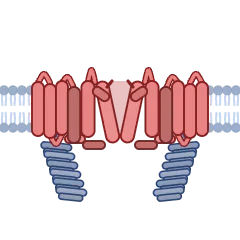 TRPV1 channel (closed)
 TRPV1 channel (open, capsaicin and heat)
 TRPA1 channel (wasabi and mustard-oil receptor)
 TRPM8 channel (cold and menthol receptor)
 Piezo1 channel, top view (three-blade propeller)
 Piezo1 channel (closed, curved membrane dome)
 Piezo1 channel (open, membrane under tension)
 MscL bacterial mechanosensitive channel
 Hair-cell tip link pulling the MET channel
Other channels 21
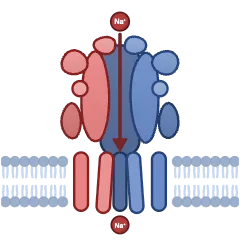 Epithelial Na⁺ channel (ENaC)
 CFTR chloride channel (closed)
 CFTR chloride channel (open, phosphorylated and ATP bound)
 Inward-rectifier K⁺ channel (Kir) with PIP2
 GIRK channel activated by Gβγ
 KATP channel (closed by ATP)
 KATP channel (opened by MgADP)
 HCN channel (pacemaker, cAMP-gated)
 Ryanodine receptor (RyR, closed)
 Ryanodine receptor (RyR, open, Ca²⁺ release)
 IP3 receptor (ER Ca²⁺ release channel)
 Ion channel, closed (simple)
 Ion channel, open (simple)
 K⁺ channel subunit topologies (2TM, 4TM-2P, 6TM)
 Ligand-gated channel subunit topologies
 CRAC channel: Orai1 gated by STIM1
 VDAC, mitochondrial outer membrane β-barrel
 Mitochondrial calcium uniporter (MCU) with MICU1/2
 Voltage-gated proton channel Hv1
 Channel gating: voltage, ligand, mechanical, temperature
 Single channel recorded by patch clamp
Pores & water channels 12
 Aquaporin with water (side view)
 Aquaporin tetramer, top view (four pores)
 Bacterial porin (OmpF trimer) in the outer membrane
 Bacterial porin trimer, top view
 Connexin hemichannel (closed)
 Connexin hemichannel (open, ATP release)
 Connexon, top view (six connexins)
 Gap junction channel (two docked connexons)
 Gramicidin channel (β-helix dimer)
 Valinomycin carrying K⁺ (mobile carrier ionophore)
 Ionomycin carrying Ca²⁺ (Ca²⁺ ionophore)
 Gap junction plaque, top view (packed connexons)
Channel blockers 8
 Na⁺ channel blocked by tetrodotoxin (TTX)
 Na⁺ channel blocked by a local anaesthetic
 hERG K⁺ channel blocked by a drug (long QT risk)
 L-type Ca²⁺ channel blocked by a dihydropyridine
 Nicotinic receptor blocked by α-bungarotoxin
 ENaC blocked by amiloride
 KATP channel closed by a sulfonylurea
 NMDA receptor pore blocked by ketamine
Transporters 35
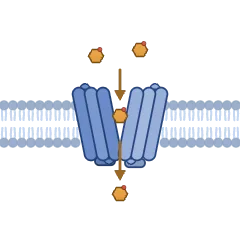 Glucose transporter GLUT (uniporter)
 GLUT2, bidirectional glucose and fructose transport
 GLUT4 translocation to the membrane (insulin)
 GLUT topology (12 transmembrane helices)
 Na⁺–glucose cotransporter SGLT (symporter)
 SGLT2 blocked by a gliflozin
 Na⁺–K⁺–2Cl⁻ cotransporter (NKCC)
 Na⁺/Ca²⁺ exchanger (NCX, antiporter)
 Na⁺/H⁺ exchanger (NHE1, antiporter)
 Cl⁻/HCO₃⁻ exchanger (band 3, AE1)
 Transporter, outward-open state
 Transporter, occluded state
 Transporter, inward-open state
 Glutamate transporter EAAT (elevator mechanism)
 Monoamine transporter (SERT, DAT, NET)
 Neurotransmitter reuptake at a synapse
 SERT blocked by an SSRI
 Dopamine transporter blocked by cocaine
 Amphetamine reversing the dopamine transporter
 Monocarboxylate transporter MCT1 with basigin
 Organic anion and cation transporters (OAT1, OCT2)
 Urate transporter URAT1
 LAT1–4F2hc amino acid transporter
 Peptide transporter PEPT1 (H⁺ symport)
 Vesicular monoamine transporter VMAT2
 Uniporter (facilitated diffusion), simple
 Symporter (co-transport, same direction), simple
 Antiporter (exchanger, opposite directions), simple
 Ferroportin blocked by hepcidin
 NPC1 exporting cholesterol from the lysosome
 Zinc transporter ZnT8 (Y-shaped dimer)
 Mitochondrial ADP/ATP carrier (AAC)
 Glucose absorption across an enterocyte (SGLT1, GLUT2)
 Membrane transport modes: diffusion, channel, carrier, pump
 Primary vs secondary active transport
Pumps & ATPases 12
 Sodium–potassium pump (Na⁺/K⁺-ATPase)
 Na⁺/K⁺-ATPase inhibited by a cardiac glycoside
 Gastric proton pump (H⁺/K⁺-ATPase)
 Proton pump blocked by a PPI (omeprazole)
 SERCA pump with phospholamban
 Plasma membrane Ca²⁺-ATPase (PMCA) with calmodulin
 P-type ATPase domains (A, N, P and M)
 V-ATPase (vacuolar proton pump)
 ATP synthase (F1Fo)
 ATP synthase dimer bending the crista
 Na⁺/K⁺-ATPase reaction cycle (E1–E2, Post–Albers)
 Bacteriorhodopsin trimer (light-driven proton pump)
ABC transporters 8
 P-glycoprotein (MDR1), inward-facing with drug
 P-glycoprotein drug efflux (outward-facing, ATP bound)
 BCRP (ABCG2) half-transporter dimer
 MRP1 (ABCC1) with its extra TMD0
 Multidrug-resistant cancer cell pumping out drug
 AcrAB–TolC multidrug efflux pump (two membranes)
 ABC importer with substrate-binding protein (maltose)
 ABCA1 loading apoA-I to make nascent HDL
GPCRs 18
 GPCR, inactive (7 transmembrane helices)
 GPCR with agonist bound (active)
 GPCR with antagonist bound (blocked)
 GPCR with heterotrimeric G protein (Gαβγ) bound
 GPCR with β-arrestin bound
 GPCR homodimer
 Metabotropic glutamate receptor dimer (class C)
 Class B GPCR with peptide hormone (GLP-1 receptor)
 Rhodopsin with retinal (light-activated GPCR)
 GPCR topology (snake plot)
 GRK phosphorylating an active GPCR
 Gs signalling: GPCR, Gαs and adenylyl cyclase (cAMP)
 Gq signalling: GPCR, Gαq and PLCβ (IP3 and DAG)
 Gi signalling: Gαi inhibits adenylyl cyclase
 Active GPCR with dissociated Gα-GTP and Gβγ
 Adhesion GPCR with GAIN domain and tethered agonist
 PAR1 activated by thrombin cleavage (tethered ligand)
 HIV envelope binding CD4 and the CCR5 co-receptor
Receptor tyrosine kinases 32
 EGFR (ErbB1), inactive tethered monomer
 EGFR dimer with EGF (phosphorylated)
 HER2 (ErbB2), extended without ligand
 HER2–HER3 heterodimer with heregulin
 HER2 bound by trastuzumab
 VEGFR, monomer (seven Ig domains)
 VEGFR dimer with VEGF (phosphorylated)
 PDGFR, monomer (five Ig domains)
 PDGFR dimer with PDGF and SH2 partners
 c-KIT (CD117), monomer with autoinhibitory juxtamembrane
 c-KIT dimer with stem cell factor
 FGFR, monomer (three Ig domains)
 FGFR dimer with FGF and heparan sulfate
 Insulin receptor (αβ)2, inactive Λ shape
 Insulin receptor with insulin (T shape, phosphorylated)
 IGF-1 receptor with IGF-1 (Γ shape)
 MET, monomer (Sema head)
 MET dimer with HGF
 ALK, monomer (MAM, LDLa and glycine-rich domains)
 ALK dimer with ALKAL ligand
 EML4–ALK fusion oncoprotein
 RET, monomer (cadherin-like domains)
 RET–GFRα1–GDNF complex
 TrkA, monomer (LRR and Ig domains)
 TrkA dimer with NGF
 EGFR kinase blocked by a TKI
 Eph receptor bound to ephrin on a neighbouring cell
 DDR1 receptor binding collagen
 TIE2 receptor with angiopoietin
 AXL receptor with GAS6 bridging to phosphatidylserine
 RTK recruiting Grb2–SOS to activate Ras
 RTK activating PI3K: PIP3 recruits AKT
Cytokine & enzyme-linked receptors 26
 Cytokine receptor with JAKs (inactive)
 Cytokine receptor signalling via JAK–STAT
 IL-2 receptor (α, β, γc) with IL-2
 IL-6 receptor complex with gp130
 Type I interferon receptor (IFNAR1/IFNAR2)
 TGF-β receptors I and II (inactive)
 TGF-β receptor complex phosphorylating SMADs
 Notch receptor bound by Delta on a neighbouring cell
 Notch cleavage and NICD release (γ-secretase)
 Wnt pathway off: Frizzled and LRP6 unbound
 Wnt bound to Frizzled and LRP6 (pathway on)
 Hedgehog pathway off: Patched inhibits Smoothened
 Hedgehog bound to Patched; Smoothened active
 TNF receptor 1 with TNF trimer
 Fas death receptor with FasL, FADD and caspase-8 (DISC)
 TLR4–MD-2 dimer with LPS
 TLR2–TLR1 heterodimer with a triacyl lipopeptide
 TLR9 in the endosome sensing CpG DNA
 Guanylyl cyclase receptor (NPR-A) with ANP
 Receptor protein tyrosine phosphatase (RPTP)
 RANKL binding RANK, and the decoy OPG
 STING dimer on the ER binding cGAMP
 Dectin-1 binding fungal β-glucan
 Bacterial chemoreceptor array (MCP, CheA, CheW)
 Two-component system: histidine kinase and response regulator
 Plant immune receptor FLS2–BAK1 with flg22
Adhesion receptors 11
 Integrin, bent (inactive)
 Integrin, extended (closed headpiece)
 Integrin, extended open and ligand-bound (with talin)
 Cadherin trans dimer (strand-swapped, with Ca²⁺)
 P-selectin binding PSGL-1 (leukocyte rolling)
 ICAM-1 (five Ig domains)
 VCAM-1 binding VLA-4 integrin
 Syndecan (heparan sulfate proteoglycan)
 CD44 binding hyaluronan
 Dystroglycan linking laminin to dystrophin
 NCAM homophilic adhesion between two cells
Uptake receptors 9
 Scavenger receptor A with modified LDL
 CD36 scavenger receptor (fatty acids and oxLDL)
 LDL receptor (domains)
 LDL receptor binding an LDL particle
 PCSK9 bound to the LDL receptor
 Transferrin receptor with transferrin
 Mannose-6-phosphate receptor carrying a lysosomal enzyme
 Asialoglycoprotein receptor with a GalNAc conjugate
 SR-BI taking up cholesterol from HDL
Nuclear receptors 6
 Nuclear receptor domains (A/B, DBD, hinge, LBD)
 Steroid receptor held by HSP90 (cytoplasm)
 Steroid receptor dimer on a hormone response element
 RXR heterodimer on a direct-repeat element
 Nuclear receptor LBD: agonist vs antagonist (helix 12)
 Hormone-bound receptor entering the nucleus
Receptor pharmacology 10
 Full agonist activating a receptor
 Partial agonist (submaximal response)
 Competitive antagonist blocking the agonist site
 Inverse agonist reducing basal activity
 Positive allosteric modulator (PAM)
 Negative allosteric modulator (NAM)
 Irreversible (covalent) antagonist
 Biased agonist (G protein vs β-arrestin)
 Orthosteric and allosteric binding sites
 Ligand–receptor binding equilibrium (kon, koff)
Receptor regulation 6
 Receptor clustering by a multivalent ligand
 Receptor internalisation in a clathrin-coated pit
 Receptor recycling or degradation after endocytosis
 Receptor downregulation (fewer receptors)
 Receptor ectodomain shedding by ADAM protease
 Ligand-induced receptor dimerisation and activation
Translocation machines 16
 Nuclear import through the nuclear pore (importin and Ran)
 Nuclear export through the nuclear pore (exportin and RanGTP)
 Co-translational translocation through Sec61
 SRP targeting a ribosome to the SRP receptor
 Sec61 lateral gate releasing a TM helix into the membrane
 SecA–SecYEG bacterial secretion (post-translational)
 Mitochondrial protein import (TOM and TIM23)
 Twin-arginine translocation (Tat) of a folded protein
 Type III secretion system (injectisome needle)
 Type IV secretion system with pilus
 Type VI secretion system (extended sheath)
 Type VI secretion system (contracted, firing)
 ER-associated degradation: retrotranslocation through Hrd1
 GET pathway inserting a tail-anchored protein
 Type II secretion system (secretin and pseudopilus)
 Autotransporter (type V secretion)